
You don’t need a gym.
You need a plan that works
at home.
Fit Life At Home is a structured fitness resource built around one reality: most people who want to get in shape don’t have a gym, a trainer, or two free hours a day. Every guide, routine, and tip here is built around that constraint not in spite of it.
Whether your goal is fat loss, building baseline strength, improving cardiovascular endurance, or simply creating a movement habit that lasts longer than three weeks the content on this site treats you as someone with a real schedule, a real living room, and a real life outside of fitness.
Why training at home produces
real results when done
correctly
The reason most people fail at home fitness isn’t a lack of motivation. It’s a lack of structure. Opening YouTube, picking a random 20-minute video, repeating it three times, and wondering why nothing changes that cycle is familiar to most people who’ve tried training without a gym.
The problem isn’t the home environment. It’s the absence of progressive programming. Effective home training uses the same physiological principles as commercial gym training: progressive overload, compound movement patterns, adequate recovery, and consistent calorie expenditure. What changes is the equipment not the science.

What actually drives results in a home setting
Bodyweight training, when programmed progressively, builds genuine muscular strength and endurance. Exercises like push-up progressions, squat variations, hip hinge patterns, and isometric holds recruit the same primary muscle groups as their barbell equivalents. The key variable is load progression something most home workout videos ignore entirely.
This site’s home workout guides are built around progressive difficulty. Each routine maps out how to advance week by week whether through additional reps, reduced rest periods, more complex movement variations, or added resistance via bands or dumbbells. That progression is what separates training from just moving around.
The gym doesn't create results. Progressive stress on the body applied consistently over time creates results. The gym is just one place to apply that stress.
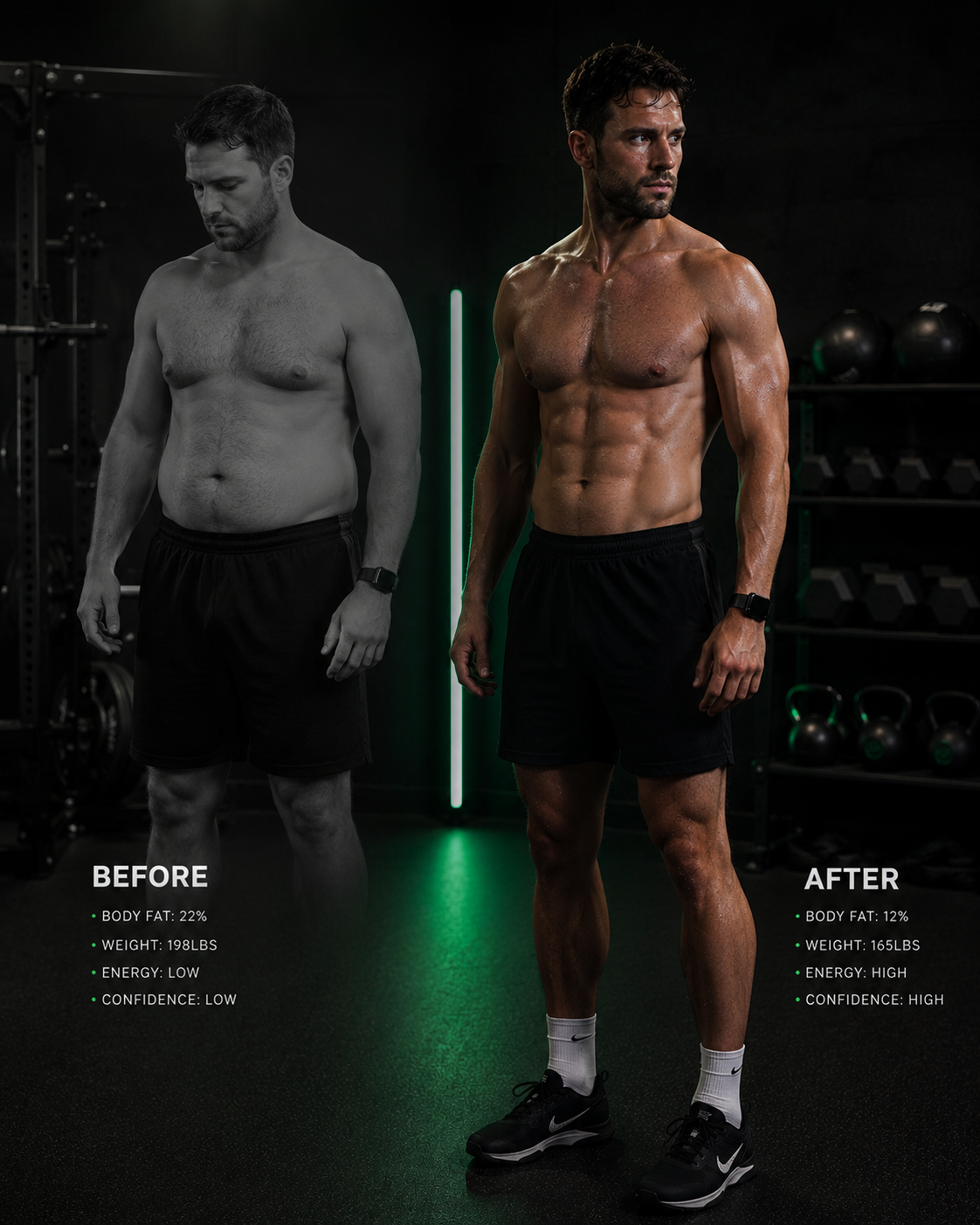
Weight Loss
Fat loss at home: what the process actually looks like, week by week
Fat loss is not complicated in principle. A consistent calorie deficit where your body burns more energy than you consume forces it to draw on stored fat as fuel. What makes it difficult is the behavioral and metabolic complexity underneath that principle.
Your body does not respond to a calorie deficit passively. As you lose weight, your resting metabolic rate adjusts. Hunger hormones like ghrelin increase. Energy expenditure from non-exercise activity walking, fidgeting, general movement tends to decrease. These are not signs of failure. They are physiological adaptations your body runs automatically, and understanding them changes how you approach the process.
0.5–1kg
Realistic weekly fat loss
Rate that preserves muscle
~500 kcal
Daily deficit needed
Via diet + exercise combined
3–4x/week
Training frequency
Minimum for fat loss + retention
Why exercise selection matters for fat loss specifically
For fat loss, the most effective home workouts combine two things: compound movements that create high total calorie expenditure during the session, and enough muscle stimulus to preserve lean mass during the deficit. Losing muscle while losing weight slows your resting metabolism further making every subsequent week harder.
Circuits that combine lower body, upper body, and core movements with short rest periods elevate heart rate significantly and sustain elevated calorie burn for hours after the session ends. This post-exercise oxygen consumption effect (EPOC) is real, measurable, and one reason structured circuit training outperforms steady-state cardio for fat loss in time-limited schedules.
This site’s home workout guides are built around progressive difficulty. Each routine maps out how to advance week by week whether through additional reps, reduced rest periods, more complex movement variations, or added resistance via bands or dumbbells. That progression is what separates training from just moving around.
Consistency is not a motivational concept — it's a metabolic one
Skipping training for two weeks doesn’t just lose momentum. It begins to reverse cardiovascular adaptations within 7–10 days. Muscle protein synthesis returns to baseline within 48–72 hours of your last training stimulus. This is why the guides here are designed to be repeatable in real life short enough to do even on difficult days, structured enough to produce actual overload when you show up fully.
Beginner Fitness
Starting fitness from zero: what nobody tells you about the first eight weeks
Most beginner fitness content is written by people who have been training for years and have forgotten what it actually feels like to start. The confusion, the delayed onset muscle soreness that makes stairs painful for three days, the uncertainty about whether you’re doing exercises correctly these are universal beginner experiences that almost no fitness website addresses honestly.
The first eight weeks of consistent training produce adaptations that are mostly neurological rather than structural. Your brain is learning to recruit muscle fibres more efficiently. Your connective tissue is adapting. Your cardiovascular system is building baseline capacity. You may not look noticeably different. You are still improving significantly and understanding that distinction is what stops most beginners from quitting in week three.

The most common beginner mistakes and why they happen
Mistake | Why it happens | What to do instead |
Starting too intensely | Motivation is highest at the start; people push before their body adapts | Train at 60–70% effort for the first two weeks |
Skipping rest days | Belief that more is always better; guilt on days off | Understand adaptation happens during rest, not training |
Changing programs weekly | Impatience; searching for the perfect plan | Commit to 6–8 weeks minimum before evaluating a program |
Ignoring movement quality | Focusing on rep counts rather than muscle engagement | Slow the tempo; feel the target muscle before adding volume |
What a beginner actually needs in their first plan
Three training days per week. Full-body sessions rather than body-part splits. Movement patterns that teach the body to hinge, squat, push, pull, and brace not isolated exercises that train muscles without teaching movement. Ten to fifteen working sets per session maximum. And a defined progression system so that week four is measurably harder than week one.
Every beginner guide on this site is built on those parameters. Nothing is assumed about prior experience. Form cues are written for someone who has never performed the exercise before, not someone who needs a reminder.

Workout Guides
What makes a workout guide actually useful and how this site builds them
A workout guide that tells you to “do 3 sets of 10 squats” without specifying the tempo, the rest period, the progression method, or how to know when you’ve done enough is not a guide. It’s a list. Lists don’t produce results.
The guides on this site are built around four design principles that most fitness content ignores: session purpose, movement rationale, progression logic, and recovery integration.

Session purpose
Every session has a defined stimulus whether that’s metabolic conditioning, strength development, mobility work, or active recovery. Mixing those stimuli randomly reduces the effectiveness of all of them. Each guide specifies what the session is trying to accomplish and why the exercises are ordered the way they are.

Movement rationale
Knowing what you’re doing matters less than knowing why. When you understand that a Romanian deadlift trains the posterior chain specifically the hamstrings and glutes under lengthened conditions, you perform it differently. You feel it differently. That muscle engagement awareness is the difference between going through motions and actually training.

Progression logic
Every guide specifies exactly how to make week five harder than week one. Volume progression, tempo manipulation, exercise variation, and load addition are all used depending on the goal. This removes guesswork entirely and prevents the plateau that comes from doing the same session indefinitely.

Recovery integration
Rest days are scheduled with the same intentionality as training days. Active recovery protocols light walking, mobility work, controlled breathing are included because they accelerate adaptation rather than interrupting it. The body rebuilds during rest. The guides reflect that physiologically.
Fitness Tips
The daily habits that determine whether your training actually works
Training three hours per week and sleeping five hours per night is not a fitness strategy. Sleep is when human growth hormone is released in its highest concentrations. It’s when muscle protein synthesis peaks. It’s when the nervous system consolidates the motor patterns you practised during training. Chronic sleep deprivation increases cortisol, impairs recovery, elevates appetite, and reduces the anabolic response to exercise. No training program compensates for this.

Non-exercise activity matters more than most people realise
NEAT non-exercise activity thermogenesis is the calorie burn that happens outside of structured training. Walking to make coffee, taking stairs, standing at a desk, pacing while on a call. In sedentary people, NEAT can account for as few as 200 calories per day. In active people, it can exceed 1,000. The difference between those two numbers is larger than most dedicated workout sessions. Increasing daily movement not just training frequency is one of the highest-leverage changes available to someone trying to lose fat at home.
Nutrition timing around training
Pre-training nutrition affects session performance. Post-training nutrition affects recovery. Neither window requires rigid rules the evidence for very specific meal timing is weaker than fitness culture suggests. What matters more is total daily protein intake (1.6–2.2g per kg of bodyweight for people training seriously) and adequate carbohydrate availability before sessions that require high output. The fitness tips section covers this without the pseudoscientific precision that makes nutrition feel more complicated than it is.
Stress, cortisol, and why you might not be recovering
Physiological stress from training and psychological stress from life use the same biological recovery systems. Someone with a demanding job, poor sleep, and three high-intensity training sessions per week may be accumulating more total stress than their body can adapt to regardless of how good their program is. The tips here address this honestly, including how to adjust training volume during high-stress periods rather than pushing through and wondering why progress has stalled.
WHO THIS SITE IS BUILT FOR
Four types of visitor and where each one should start
THE ABSOLUTE BEGINNER
“I’ve never exercised consistently. Where do I even start?”
Start with the beginner workout plans. Three days per week, full body, no equipment required, written with zero experience assumed.
THE TIME-CONSTRAINED ADULT
“I have 20–30 minutes, maybe four days a week. Is that enough?”
Yes ,if those sessions are structured correctly. The short-session guides are designed for this constraint, not adapted from longer ones.
THE REPEAT QUITTER
“I’ve started three times and quit. I don’t know what I’m doing wrong.”
Usually the problem is starting intensity, not discipline. The beginner guides are calibrated to be sustainable through week eight, not just week one.
THE WEIGHT LOSS SEEKER
“I want to lose fat but don’t want to do cardio every day.”
The fat loss guides priorities resistance-based circuits over steady cardio better for muscle retention and sustainable longer term.
What this site will and will not tell you
Fitness content online is saturated with exaggerated claims, affiliate-driven supplement recommendations, and programs designed to look impressive rather than actually work. This site operates differently not as a positioning statement, but as a practical commitment to what is in every piece of content published here.
No "lose 10kg in 30 days" claims
Realistic timelines stated clearly
No supplement promotions
Exercise form prioritised over rep counts
Beginner-safe progressions only
Physiology explained, not hidden
Progress in fitness takes weeks and months, not days. What works is usually simpler than what is being sold. The goal of this site is to explain the actual mechanisms clearly enough that you can make informed decisions not just follow instructions without understanding them. That understanding is what makes the difference between someone who trains for six months and someone who trains for six years.
Find the right starting point for where you are now
You don’t need to read everything. Pick the guide that matches your current situation and start there. Every guide links to the next logical step when you’re ready to progress.